Sunday, August 8, 2010

VIDEO: The Corrido of Esteban Jordan, Interview

http://www.npr.org/templates/story/story.php?storyId=104845790&sc=nl&...

The Corrido of Esteban Jordan, Interview

Esteban Jordan Interview courtesy of NPR.ORG

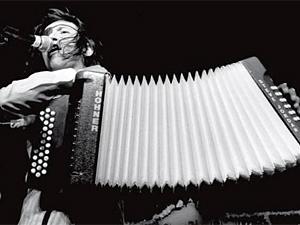
The Corrido Of The 'World's Best Accordionist'

Esteban Jordan
Courtesy of the artist

Even in failing health, Esteban "Steve" Jordan is planning to issue nine previously unreleased albums, on which he plays all the instruments.

June 2, 2009 - It's a warm night under a full moon on the west side of San Antonio. On this night, all the bands at the annual Tejano Conjunto Festival are paying tribute to Steve Jordan.

From the door of an RV steps the gaunt accordionist. At 70, he's still the peacock: He wears a shiny gold shirt with puffy sleeves, a purple vest, purple bell-bottoms, black boots and his iconic black eye patch.

His fans are fanatics. One longtime follower has a picture of El Parche — Jordan's nickname, owing to the eye patch — tattooed on his bicep.

"I've been listening to Steve since probably 1980," says Joe Rodriguez, a fan. "There hasn't been any other fascinating musician that can defy gravity, actually, and can bend time and bend sound."

Welcome to the world of Steve Jordan: where time and sound bend, and accordions can fly.

In the world of Mexican-American music, Jordan is a legend: He's done things on the button accordion that had never been done before, or in some cases since. Though his health is now failing, the 70-year-old is still performing — and set to embark on a new phase of his career.

The Rise Of Jordan

Jordan was a musical child prodigy who never went to school and, to this day, cannot read or write. Nearly blinded at birth in both eyes by a clumsy midwife, he picked up the accordion for the first time at a migrant labor camp in Texas when he was 7.

Over a long, turbulent career drenched in booze and drugs, he played everything he heard, and learned every instrument he got his hands on. He was even good enough to play guitar with Willie Bobo's Latin jazz band in 1964. It is said that he's his own genre.

"What Steve Jordan did was, he electrified the accordion," says Sunny Sauceda, a rising star on the squeezebox. "He used pedals, he brought in jazz influences to the accordion playing. He brought in the effects that had never been done on the accordion — to this day, nobody does it."

Those effects — like phase shifters, fuzzboxes and echoplexes — gave rise to the label that Jordan hates to this day: "the Jimi Hendrix of the accordion."

Then there's the whole jazz thing, says Joel Guzman, an acclaimed traditional accordionist from Austin, Texas. "He's playing flat-fifths and raised 11ths, rhythmically so deep," Guzman says. "So, from a musical standpoint, he's a genius."

The Man, The Myth

Jordan's music and his persona are inseparable.

"The patch, right, that just adds a whole 'nother mystique — his pirate, pachuco, barrio dude, hip cat," says Juan Tejeda, coordinator of San Antonio's Conjunto Festival. "Yeah, man, he's too much."

But Tejeda also says Jordan is getting frail, and looks like he's in pain.

"This is his destiny, man. He's gonna die playing," Tejeda says. "He's gonna die onstage — that's Steve."

Jordan's liver is diseased with cirrhosis and cancer. He underwent chemotherapy last year. But Jordan says he feels good these days. And he's finally begun granting interviews — he used to be notoriously elusive. Though he's ailing, he's still got the old attitude.

"Right now, I'm so far advanced that nobody can catch up to me," Jordan says. "Nobody, I mean, that includes nobody. Do you understand what I'm saying?"

Esteban Jordan grew up the youngest of 15 siblings in a family of southern Texas farmworkers. They picked sugar beets in Colorado, cotton in Arizona, figs in California. But Jordan couldn't work in the fields.

"I couldn't see a damn thing," he says. "I was a young kiddie. And I was turned loose at that age: Go ahead on, find yourself something to do."

Jordan says he started making a living as a musician when he was 7. By the late 1980s, it looked like his career was finally taking off. He played the Berlin Jazz Festival, had a Grammy-nominated album and played the soundtrack for Cheech Marin's Born in East L.A. Hohner even produced the "Steve Jordan Tex-Mex Rockordion."

Back then, some even started calling him "the world's best accordionist."

Taking Charge

Jordan should have ridden that wave 20 years ago. He should be set now, sitting back, enjoying the fruits of his international renown. (He has rabid fans in Germany and Japan.) But he says he isn't seeing any royalty payments.

"Nada," he says. "Not a half a penny. They've been taking advantage of the handicapped."

He isn't too happy about it, either.

"Of course I'm bitter," Jordan says. "Everybody's living in Oceanside, and here I am living over here, a poor little dude."

He speaks from the living room of his rundown rental house. The linoleum is cracked, and two dogs mill about a bare front yard.

But Jordan has a plan to finally take charge of his music. He says he has nine CDs' worth of unreleased material in which he plays and overdubs every instrument. He's mixing it at his house, which he shares with his two sons, Esteban III and Richard.

"He did it all himself: He recorded the bass, the guitar, the violins, cellos," Richard Jordan says. "People ask me, man, they call us every day, 'Hey, man, when can we get the record,' blah, blah, blah. They just waitin' like a shot in the arm, they're waitin' for it."

The backroom studio is crammed with all the equipment they need to mix and produce albums on their own. The first release will be titled Carta Espiritual, or "Letter to God." Which is quite different from earlier compositions like "Piedrecita," or "The Little Rock" — a paean to cocaine.

But you won't hear a sample of it here. Jordan is famously paranoid about people ripping off his music.

"I'll give you a taste of it, but not in there," he says, pointing to the microphone. "You gotta understand that. I don't want it here."

He taps the microphone suspiciously. When he's sure the recorder is turned off, he plays some of his new material; it's vintage Steve Jordan. He says the first CD on his new label will be available at estebanjordan.com later this summer.

For now, if you want to hear the essential Steve Jordan, you can still go to San Antonio, to a tiny club called Salute on North St. Mary's Street. He and his sons still play every Friday night under the name River Jordan.

You'll hear one of the best accordion players in the world.
Posted via email from ttexed's posterous

VIDEO: MAGNESIUM PROVERBS 1: The True Life Story of SYD BARRETT


by IndicaUnlimited 

'He would see and hear things no one else ever did,’ remembered Rosemary. ‘Colours were the thing. I wouldn’t be at all surprised if he had a condition like synaesthesia because a sound was a colour to him.'

‘Syd was one of the spearheads, and main inspirational figures of the sixties’ so-called psychedelic movement,’ asserts Pete Brown. ‘Undoubtedly one of two or three people who widened English lyric writing. He made it possible for English people to write about being English, briefly. I have a strong image of him as a terrific performer. Barrett was incredibly charismatic on-stage. He became a hero very fast, moving into uncharted territory.'

Posted via email from ttexed's posterous

Saturday, August 7, 2010

John Peel in Dallas


Fillerzine | August 26, 2009

John Peel, recorded June 23,1996:

"I went over there the beginning-to-middle of 1960. The first radio programs I did were on a station called WRR in Dallas and they had a rhythm & blues program called Kats Karavan, spelled inevitably with two K's. I'd gotten some British LPs of blues and rhythm & blues stuff that were only available in Britain, or in Europe anyway, so I went along and played them some of those records and they put me on the radio to talk about them. I thought they'd probably put me on there because of my extraordinary knowledge of the music, but I think in fact they probably put me on there because they found my accent very entertaining because in those days I used to talk a bit like Prince Charles." ...

"This was not the day that Lee Harvey Oswald was shot by Jack Ruby; it was a few days before that. It was when he was kind-of presented to the press as the man who'd been arrested and charged. And, I mean, it was just one of those things that -- Earlier on when the assassination first happened, and I'd been - I used to work here for an insurance company on Central Expressway, so I was able to get into town pretty quickly. I was an office boy, so I could come and go as I pleased, and so when I heard about the assassination, it was announced on the P.A. in the office, and I just drove into town and went to the police cordon and told the policeman, I said, "I'm from The Liverpool Echo" and instead of telling me to piss-off, he let me through. It's one of those things which sounds so bizarre. And I walked down - I didn't go to the grassy knoll - I just stood on the other side of the road and kind of watched what was going on until frankly it became boring. It's hard to imagine that it did, but after I stood there about 40 minutes and watching people scurrying about, so I then went and made what I'd said kind-of retrospectively true and phoned The Liverpool Echo, and funnily they weren't terribly interested. I thought, Cripes, here's my chance because I've always wanted to be in journalism, so I thought, hey, this is my chance to get into journalism. I could be The Liverpool Echo's "Man in Dallas", but they really didn't care. So I was a bit wounded by that, but then that night a mate of mine and I had been driving around and were trying to figure out what to do, and at the end of the evening I said, why don't we go down to the police headquarters and see what's going on. And we got down there, and I said to this policeman, I said "what's happening?" And he said, "Well, actually there's a press conference down here," pointing to a flight of steps into the basement of the building - "there's a press conference in here in a few minutes." And I said, "Well, actually I'm from The Liverpool Echo and this is my photographer," and we went down there. I mean, we didn't have a pen or paper or camera between us, but we went in there anyway. It's a story that I've told so often that you get to the point where you don't really believe it yourself, it just seems so unlikely. But then in one of the bits of film of that press conference, we were all standing in this room and they had the identification parade in the basement of this building and they said - Henry Wade said - that this is the man that's been charged in the assassination of President Kennedy, and they brought in Lee Harvey Oswald. And he stood there looking slightly puzzled and alarmed for a while, and then was taken away again. In one of the films of this, which they showed on British television, they showed that Jack Ruby was in the room as well - which I didn't know he was until I saw this film they sort-of panned across the room and in the last few frames you can see me and my friend Bob standing there looking like tourists." ...

"None at all, no. I wish, I don't know, y'know, I think, I mean, everybody else does, but I think we'll probably never know the truth."

John Peel, interview recorded June 23, 1996. Published Sept. 1996 (Filler #5). Soundtrack music "Comment Naissent des Meduses" from "Science is Fiction," written & performed by Georgia Hubley, Ira Kaplan, James McNew (Yo La Tengo).

For full interview transcript, visit: http://tinyurl.com/n82mc4


Posted via email from ttexed's posterous

Friday, August 6, 2010

accidental mysteries: Vote for Some Great Books! (Jim Linderman)

http://accidentalmysteries.blogspot.com/2010/08/vote-for-some-great-books.html

A BLOG ABOUT PHOTOGRAPHY, DESIGN, ART, ARCHITECTURE, EPHEMERA, FOUND OBJECTS, POP CULTURE, ANONYMOUS, OUTSIDER ART, FOLK ART, SELF-TAUGHT ART, ILLUSTRATION, BEAUTY, ESOTERICA, AUCTIONS, DISCOVERY, ART ENVIRONMENTS, MYSTERY, VINTAGE STUFF AND THE MAGIC THAT CAN BE FOUND IN EVERYDAY THINGS.

THURSDAY, AUGUST 5, 2010


MY GOOD FRIEND JIM LINDERMAN creates unusual, uncommon and authentic Art and Photography Books. I have bought several and they are rare and wonderful additions to my library.

Jim Linderman’s first book “Take Me to the Water: Immersion Baptism in Vintage Music and Photography 1890-1950” was published by Dust-to-Digital and nominated for a Grammy in the Best Historical Release category. It is available from the publisher or Amazon. 

Jim is up for an award through Blurb Books and I’d be right happy and darned proud if all you Accidental Mysteries readers would click on each one of his book images below, check ’em out and VOTE in the spot where it says “vote.” And while you’re at it, if you see a book you like, you can order your own copy.

As always, if any reader finds the images of 1950’s nude camera girls like the immortal Bettie Page offensive in any way, please just move forward and vote for the next book!

By the way, for this limited time (and during the voting process) you can look at every page of the entire book for free by clicking “preview” at Blurb, then “full screen” and use their page turning software to read and check out the books.

Camera Club Girls
Bettie Page and her...
By Jim Linderman
Photo book

(ABOVE; Camera Club Girls, Click on book above and VOTE inside)

For over 50 years, the extraordinary Hand-Painted Original Photographs of Bettie Page and nude models of the 1950s taken by Rudolph Rossi lay hidden. Now, for the first time, over 100 have been published in Camera Club Girls by Jim Linderman. 114 pages, 35 pages of text and 180 pictures, the book tells the story of the informal groups of early camera enthusiasts in New York City who paid ten dollars each to photograph naked women, including Bettie Page, in dingy studios and outdoor excursions. As much the history of early erotic photography and Times Square smut as it is the story of the exceptional personal vision of an artist, master photographer and painter which has not been told until now. The photographic find of the decade, and an amazing story which combines passion, painting, photography and early porno in a tale never told.

187 Photographs, 114 Pages Hardcover or Softcover.
By Jim Linderman and Dull Tool Dim Bulb Books


The Painted Backdrop
Behind the Sitter i...
By Jim Linderman DUL...
Photo book

(ABOVE; 
The Painted Backdrop, Click on book above and VOTE inside)

The previously untold story of 19th century painters and their influence on American photography during the tintype era. Never before examined in detail, the book contains over 75 rare, unpublished original tintype photographs from the Jim Linderman collection. A Grammy nominated writer and collector who has been called “the perfect subject for a Harvey Pekar comic” this book is informed with Linderman’s wit and continues his examination of previously overlooked art and photography subjects. 80 Pages, 8’ x 10” with essays by Jim Linderman and Kate Bloomquist. Linderman’s most recent photography book was Camera Club Girls which tells the story of the amateur photographers who met to take nude photographs during the 1950s, discovered model Bettie Page, and started a revolution in erotic art...all through the work of one never before published artist.

By Jim Linderman and Dull Tool Dim Bulb Books

The Jim Linderman hub site is Dull Tool Dim Bulb and his daily blog (one of many he maintains) is here. 

Posted via email from ttexed's posterous

Bukowski Radio Interview From 1980s

http://bukowski.net/forum/showthread.php?7428-Bukowski-Radio-Interview-From-1...

Bukowski Radio Interview From 1980s

bathroommonkey76 | July 29, 2010

Summary: An interview with Charles Bukowski precedes his reading of his poem, Do you use a notebook?, from the collection Dangling in the tournefortia.

http://www.amazon.com/Dangling-Tourne...

This was apparently an audio magazine series called A Moveable Feast, distributed on cassette. (I also seem to recall hearing some segments on my public radio station.) This mp3 was picked up long ago on HotLine-- anyone old enough to remember it??

Even though the pic above is of a CD case, the only trace I can find of this recording is on audio cassette (and they're out of print). That's the source of this mp3

The tape is hissy, and the mp3 isn't encoded that well, with a couple spots of stuttering and repetition, but it's all very minor. And the tape itself is now over 20 years old and doesn't seem to be as easy to find as his albums.


Posted via email from ttexed's posterous

Tuesday, August 3, 2010

FBI Demands Its Logo Be Removed From Wikipedia

http://gawker.com/5603572/

FBI Demands Its Logo Be Removed From Wikipedia

FBI Demands Its Logo Be Removed From WikipediaThe FBI is hopping mad at Wikipedia! Apparently they've threatened Wikipedia with legal action if the online encyclopedia doesn't remove a picture of its official seal from the FBI entry at once. Wikipedia's lawyers, while squelching laughter, have replied "no."

The FBI's lawyers claim that keep a high-resolution image of its official seal violates federal code banning the manufacture, sale or possession of items bearing the insignia of federal offices.

The New York Times explains Wikipedia's response, which is essentially "oh shut up FBI."

The problem, those at Wikipedia say, is that the law cited in the F.B.I.'s letter is largely about keeping people from flashing fake badges or profiting from the use of the seal, and not about posting images on noncommercial Web sites. Many sites, including the online version of the Encyclopedia Britannica, display the seal.

You legal nerds out there might enjoy a brisk, pleasant read of Wikimedia general counsel Mike Godwin's entire letter to these FBI trolls. Godwin, a sassy fellow, accuses the FBI of deliberately misrepresenting the law:

Finally, while I sympathize with your footnoted desire to claim that "the plain meaning" of the statute supports your broad view of Section 701's scope, we note that you specifically removed the language that communicates the plain meaning of "other insignia." In context, this seems an ironic stroke.

The FBI is definitely going to raid their offices, like, tonight.

Send an email to Jim Newell, the author of this post, at newell@gawker.com.

Posted via email from ttexed's posterous

zenhabits: 7 Simple Ways To Say “No”

http://zenhabits.net/say-no/

7 Simple Ways To Say “No”


Saying “no” doesn’t have to be hard. Image source

Editor’s note: This is a guest post from Celestine Chua of The Personal Excellence Blog.

Do you have difficulty saying “no”? Are you always trying to be nice to others at the expense of yourself?

Well, you’re not alone. In the past, I was not good at saying “no”, because I didn’t want to hurt the other person’s feelings.

For example, whenever I get requests for help, I would attend to them even though I had important work to do. Sometimes the requests would drag to 2-3 hours or even beyond. At the end of the day, I would forgo sleep to catch up on my work. This problem of not knowing how to say “no” also extended to my clients, business associates and even sales people.

After a while, I realized all these times of not saying “no” (when I should) were not helping me at all. I was spending a lot of time and energy for other people and not spending nearly as much time for myself. It was frustrating especially since I brought it upon myself. I slowly realized if I wanted personal time, I needed to learn to say “no”.

Why We Find It Hard To Say “No”

To learn to say “No”, we have to first understand what’s resisting us about it. Below are common reasons why people find it hard to say no:

  1. You want to help. You are a kind soul at heart. You don’t want to turn the person away and you want to help where possible, even if it may eat into your time.
  2. Afraid of being rude. I was brought up under the notion that saying “No”, especially to people who are more senior, is rude. This thinking is common in Asia culture, where face-saving is important. Face-saving means not making others look bad (a.k.a losing face).
  3. Wanting to be agreeable. You don’t want to alienate yourself from the group because you’re not in agreement. So you confirm to others’ requests.
  4. Fear of conflict. You are afraid the person might be angry if you reject him/her. This might lead to an ugly confrontation. Even if there isn’t, there might be dissent created which might lead to negative consequences in the future.
  5. Fear of lost opportunities. Perhaps you are worried saying no means closing doors. For example, one of my clients’ wife was asked to transfer to another department in her company. Since she liked her team, she didn’t want to shift. However, she didn’t want to say no as she felt it would affect her promotion opportunities in the future.
  6. Not burning bridges. Some people take “no” as a sign of rejection. It might lead to bridges being burned and relationships severed.

If you nodded to any of the reasons, I’m with you. They applied to me at one point or another. However, in my experience dealing with people at work and in life, I realized these reasons are more misconceptions than anything. Saying “No” doesn’t mean you are being rude; neither does it mean you are being disagreeable. Saying “No” doesn’t mean there will be conflict nor that you’ll lose opportunities in the future. And saying no most definitely doesn’t mean you’re burning bridges. These are all false beliefs in our mind.

At the end of the day, it’s about how you say “no”, rather than the fact you’re saying no, that affects the outcome. After all, you have your own priorities and needs, just like everyone has his/her own needs. Saying no is about respecting and valuing your time and space. Say no is your prerogative.

7 Simple Ways To Say “No”

Rather than avoid it altogether, it’s all about learning the right way to say no. After I began to say no to others, I realized it’s really not as bad as I thought. The other people were very understanding and didn’t put up any resistance. Really, the fears of saying no are just in our mind.

If you are not sure how to do so, here are 7 simple ways for you to say no. Use the method that best meets your needs in the situation.

1. “I can’t commit to this as I have other priorities at the moment.”

If you are too busy to engage in the request/offer, this will be applicable. This lets the person know your plate is full at the moment, so he/she should hold off on this as well as future requests. If it makes it easier, you can also share what you’re working on so the person can understand better. I use this when I have too many commitments to attend to.

2. “Now’s not a good time as I’m in the middle of something. How about we reconnect at X time?”

It’s common to get sudden requests for help when you are in the middle of something. Sometimes I get phone calls from friends or associates when I’m in a meeting or doing important work. This method is a great way to (temporarily) hold off the request. First, you let the person know it’s not a good time as you are doing something. Secondly, you make known your desire to help by suggesting another time (at your convenience). This way, the person doesn’t feel blown off.

3. “I’d love to do this, but …”

I often use this as it’s a gentle way of breaking no to the other party. It’s encouraging as it lets the person know you like the idea (of course, only say this if you do like it) and there’s nothing wrong about it. I often get collaboration proposals from fellow bloggers and business associates which I can’t participate in and I use this method to gently say no. Their ideas are absolutely great, but I can’t take part due to other reasons such as prior commitments (#1) or different needs (#5).

4. “Let me think about it first and I’ll get back to you.”

This is more like a “Maybe” than a straight out “No”. If you are interested but you don’t want to say ‘yes’ just yet, use this. Sometimes I’m pitched a great idea which meets my needs, but I want to hold off on committing as I want some time to think first. There are times when new considerations pop in and I want to be certain of the decision before committing myself. If the person is sincere about the request, he/she will be more than happy to wait a short while. Specify a date / time-range (say, in 1-2 weeks) where the person can expect a reply.

If you’re not interested in what the person has to offer at all, don’t lead him/her on. Use methods #5, #6 or #7 which are definitive.

5. “This doesn’t meet my needs now but I’ll be sure to keep you in mind.”

If someone is pitching a deal/opportunity which isn’t what you are looking for, let him/her know straight-out that it doesn’t meet your needs. Otherwise, the discussion can drag on longer than it should. It helps as the person know it’s nothing wrong about what he/she is offering, but that you are looking for something else. At the same time, by saying you’ll keep him/her in mind, it signals you are open to future opportunities.

6. “I’m not the best person to help on this. Why don’t you try X?”

If you are being asked for help in something which you (i) can’t contribute much to (ii) don’t have resources to help, let it be known they are looking at the wrong person. If possible, refer them to a lead they can follow-up on – whether it’s someone you know, someone who might know someone else, or even a department. I always make it a point to offer an alternate contact so the person doesn’t end up in a dead end. This way you help steer the person in the right place.

7. “No, I can’t.”

The simplest and most direct way to say no. We build up too many barriers in our mind to saying no. As I shared earlier in this article, these barriers are self-created and they are not true at all. Don’t think so much about saying no and just say it outright. You’ll be surprised when the reception isn’t half as bad as what you imagined it to be.

Learn to say no to requests that don’t meet your needs, and once you do that you’ll find how easy it actually is. You’ll get more time for yourself, your work and things that are most important to you. I know I do and I’m happy I started doing that.

Celes writes at The Personal Excellence Blog on how to achieve our highest potential and live our best life. Get her free ebook “101 Things To Do Before You Die” by signing up for her free newsletter.

Posted via email from ttexed's posterous

Sunday, August 1, 2010

Carnival Saloon/Nigel Smith: Marty Robbins' El Paso Trilogy

http://carnivalsaloon.blogspot.com/2010/06/marty-robbins-el-paso.html

Nigel Smith

Marty Robbins - El Paso


The El Paso Trilogy - Part 1

Marty Robbins' El Paso was a number one hit in 1959 on both the country and pop charts. I'm sure I probably first heard it on one of the country compilations my dad used to play in the car when we were kids. I didn't reallyhear the song though until I bought Tom Russell's tremendous albumIndians Cowboys Horses Dogs after seeing him play for the first time at the Cambridge Folk Festival in 2006. The way Tom sings it, starting with his cowboy yelp against the accordion that plays throughout, it's like an old Western movie in miniature. It's certainly not hard to imagine Katy Juradoplaying Feleena and Randolph Scott as her ill-fated lover. 

MP3: Tom Russell - El Paso

Find it on Indians Cowboys Horses Dogs

Two things have recently made me think about the original. First, I finally got a copy when I bought an Ace Records compilation of cross-over country hits from the 50s and 60s. Secondly, I'm currently reading Dana Jennings'fascinating book Sing Me Back Home. It mixes a thesis that country music from 1950 to 1970 represents a "secret history of rural, working class Americans in the 20th century" with memories of Jennings' own Faulknerian family of "adulterers, drunks, and glue sniffers; wife beaters, husband beaters, and child abusers; pyros, nymphos, and card cheats; smugglers and folks who were always sticking their cold, bony hands where they didn't belong."

It's always worth thinking about the context in which music was created. As Jennings points out, country music really only became known as country and western music in an attempt to "shed its 'hillbilly' stigma" and "take advantage of the nation's love affair with Westerns, with singing cowboys and their faithful horses". In 1959 Westerns were ubiquitous, especially on TV with Bonanza, Gunsmoke, Rawhide and Maverick just the well-known small-screen cowboy adventures. In the same year cinema-goers flocked to see John Wayne in the Howard Hawks classic Rio Bravo. 

MP3: Marty Robbins - El Paso

Find it on The Golden Age Of American Rock'n'Roll - Country Edition

With six-shooters so prevalent in pop culture it's no wonder that El Paso was a hit. Yet Columbia'a A&R boss Mitch Miller wasn't so sure and nearly rejected it. He felt the song was too long (singles in the 50s seldom exceeded four minutes) and too wordy. In rebuttal Robbins cited Johnny Horton's hit The Battle of New Orleans from earlier in the year as proof that there was a market for narrative songs with a Western flavour. As a compromise Columbia released a radio edit. America's DJs vindicated Robbins by choosing to play the full-length version that was on the flip. 

El Paso became Marty Robbins' signature song. Although he was born in Arizona and is buried in Nashville, the Texas city he made famous even named a park in his honour. Robbins was also unable to leave the song alone. In 1966 he released its first sequel, Feleena, which he followed ten years later with El Paso City. More on both of those songs later in the week. 

http://carnivalsaloon.blogspot.com/2010/06/marty-robbins-feleena-from-el-paso...

Marty Robbins - Feleena (From El Paso)


The El Paso Trilogy - Part 2

In my previous post I wrote how Marty Robbins had to fight his record label bosses to release El Paso in 1959 because they felt it was too long and too wordy. Marty won and the song became a Grammy-winning hit and country music standard. Robbins revisited that West Texas town with a sequel on his 1966 album The Drifter. Feleena (From El Paso) tells the story from the girl's perspective and at over eight minutes is twice as long as the original.

As well as a lengthy back-story before Feleena reaches El Paso the song also adds an extra layer of tragedy. The original El Paso ends with the narrator dying in Feleena's arms. In the sequel Feleena then takes her own life with her lover's pistol after hearing his parting words. There's then a marginally upbeat coda as we learn that the two lovers' voices can still be heard in the streets of El Paso.

MP3: Marty Robbins - Feleena (From El Paso)

Find it on The Essential Marty Robbins

Here's a video of Marty performing the song. Unfortunately I have no idea where it's from.

Rosa's Cantina features in both songs. I actually discovered the photo at the top of this post on Jim Peipert's cycling blog. It really is the same place that inspired the song. According to Jim, Marty Robbins stopped off at Rosa's on his trips back home to Arizona after performing at the Grand Ole Opry in Nashville.* 

As far as I know song sequels like Feleena are pretty unusual. The only other one I can think of is Chuck Berry's Bye Bye Johnny, which tells the story of Johnny B Goode from his mother's point of view. If you know of any others, please do leave a comment.

I'll be concluding my posts on Marty Robbins' El Paso trilogy later in the week. Stay tuned for a particularly odd song.

* In a comment below Marty Robbins' biographer Diane Diekman says my trivia that Robbins was inspired by a real-life Rosa's Cantina is nonsense. I'm always happy to be corrected!

3 COMMENTS:

Diane Diekman said...1

Marty didn't stop in El Paso; he drove through it on his way home to Arizona for Christmas--three years in a row in the mid-fifties. He made up the name of "Rosa's Cantina" and didn't know such a place existed. My biography of him, "Twentieth Century Drifter: The Life of Marty Robbins" (to be published in 2012), quotes interviews where he told that story.

Nigel Smith said...2

@Diane - thanks for clarifying the truth about Rosa's Cantina. I have amended the text above. You can't believe what your read on the internet! I look forward to reading your book.

Curt Shannon said...3

Thanks for posting; I never knew about this song. The studio version is OK, but the video is even better - just Marty and his guitar. None of the lip-synching that makes watching TV performances of this era so cheesy.

Posted via email from ttexed's posterous